The Hawken Rifle: History, Calibers, and Modern Replicas
The Hawken is the large-bore muzzleloading rifle that became the working standard of the American fur trade. Built in St. Louis from the 1820s, it traded the long, slender lines of the eastern Kentucky long rifle for a shorter, heavier barrel and a much bigger bore, commonly .50 to .54 caliber, built for big game on the open plains.
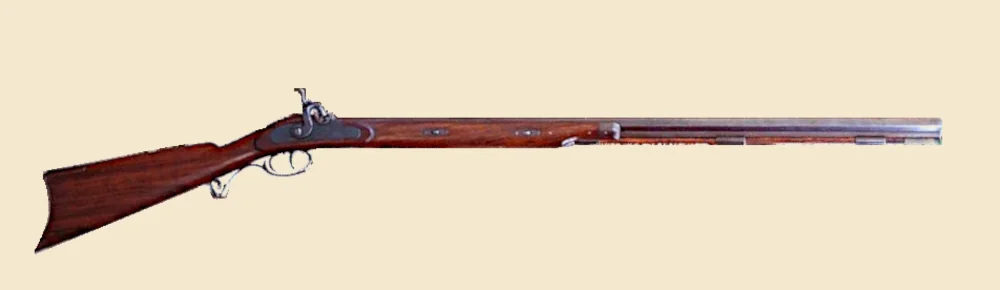
The Hawken was the mountain men’s chosen weapon: a short, big-bored muzzleloader built in St. Louis for the western fur trade, and for a generation it was the standard arm of the Rockies. It earned that place by being the opposite of the eastern Kentucky long rifle, which was slim, small in the bore, and well over a meter long, fine in the forests of the East but awkward on horseback and too light to stop a bison, an elk, or a grizzly. The Hawken brothers built the answer: shorter, far heavier in the bore, and stout enough to work years from the nearest gunsmith.
The shop on the edge of the frontier
Jacob and Samuel Hawken were brothers working in St. Louis, then the gateway to the entire western trade. Their partnership, trading as J. & S. Hawken, ran from 1825 until Jacob’s death in the cholera year of 1849. Samuel carried the business on into the early 1860s, when he sold it to a former employee, J. P. Gemmer, under whom the shop survived until 1915. In the partnership’s prime the brothers built the rifle that defined the type now known generically as the plains rifle or mountain rifle.
Everything about the design was a response to the plains. The barrel was cut shorter and made thicker, so it balanced for a mounted man and stood up to heavy charges of powder. The large bore matched the size of the western game. Many were fitted with a double set trigger, which let a hunter set a feather-light release for a careful shot. The furniture was plain and stout where the eastern rifles were often slender and decorated, because a mountain rifle had to survive years away from any gunsmith. The result was not elegant, but it was trusted.
A shorter, much heavier rifle than the Kentucky long rifle it descended from, the Hawken was built around a large bore, commonly .50 to .54 caliber, averaging about .54, with surviving examples ranging as large as roughly .68. By the rifle’s heyday, ignition was percussion (caplock); earlier examples were flintlock, with the percussion lock becoming dominant on the Hawken by about 1835, ahead of the older eastern long rifles, which held to flint longer.
Who carried a Hawken
The rifle is bound up with the legend of the fur trade, and the association is largely earned. Hawken rifles are traditionally linked to figures such as Jim Bridger, Kit Carson, and Hugh Glass, among other trappers and guides of the 1830s and 1840s. These attributions are best treated as historical association rather than serial-numbered provenance; the records of who owned which rifle are thin, and the Hawken’s fame has a way of drawing every mountain-man story toward it. What is certain is that the type was the working standard of the western trade for a generation.
That trust is also why the Hawken name attached itself to the mountain men whether or not every rifle they carried actually came from the brothers’ shop. The plains rifle was a category before it was a brand, and the Hawken shop built the best-known examples of it.
The Hawken on screen
The rifle reached a modern audience through the 1972 film Jeremiah Johnson, directed by Sydney Pollack, in which Robert Redford’s title character carries one as his prized rifle. The film is credited with helping drive a revival of interest in traditional muzzleloading, though the guns used on screen only loosely resembled true Hawken-pattern rifles. The screen Hawken is a piece of cultural shorthand, not a technical record, and the gap between the two is a fair measure of how far the legend has traveled from the workbench.
What caliber is a Hawken
Why so large a bore? Because the game was. The whole point of the design was to throw a ball heavy enough for bison, elk, and bear on the western plains and in the Rockies, which a small-bore eastern rifle simply could not do. That logic still shapes the choice a modern shooter makes between the two common calibers: the .50 is a little flatter-shooting and easier on lead and powder, while the .54 hits harder on large game. Either sits squarely in the historic range; the rare originals that run up toward .68 were big-game rifles taken to an extreme.
Original, vintage, or replica
It helps to keep three categories of “Hawken” separate, because they trade in very different markets and a price that looks too good for an “original” usually means a replica.
An original is a rifle from the Hawken brothers’ own St. Louis shop, made before it changed hands in the early 1860s: a documented antique, rare and expensive, held now by collectors and museums. These are objects of study rather than guns anyone shoots. A vintage rifle is a genuine nineteenth-century plains rifle of the same type from another maker of the period, a working antique rather than a current product. A modern replica is a current-production rifle built to the Hawken pattern, and it is what almost every shooter and reenactor actually carries.
Who makes a Hawken today
The rifles that keep the tradition alive are modern replicas, and the makers are worth telling apart. The largest traditional-muzzleloader maker, the Italian firm Davide Pedersoli, produces Hawken-pattern rifles and is the name that recurs most often, working in the same European gunmaking tradition the Hawken brothers drew on. Investarm, also Italian, builds Hawken-style rifles and has long supplied other brands. A buyer will also see the Lyman Great Plains Rifle, a Hawken-pattern gun built by other manufacturers under the Lyman name, historically Investarm and more recently Pedersoli. The much-loved Thompson/Center Hawken introduced a whole generation to the type, but it is now discontinued and found only on the used market. Budget Hawken-style rifles are also offered by makers such as Traditions.
The brothers’ shop closed in 1915, but the rifles never really stopped being made. What survived them is the form itself: a short heavy barrel, a large bore, plain stout furniture, kept in production for the same reason it was built, because it works.
Common questions
What is a Hawken rifle?
A Hawken is a large-bore muzzleloading rifle built in St. Louis from the 1820s for the western fur trade. It is shorter and far heavier in the bore than the eastern Kentucky long rifle it descended from, commonly .50 to .54 caliber, and it became the working standard of the mountain men. The name now describes the plains-rifle pattern as much as the original maker.
What caliber is a Hawken rifle?
The Hawken is a large-bore rifle. The calibers most associated with the type are .50 and .54, with the average around .54, and surviving examples range larger still, up to roughly .68. The large bore is the point of the design: it threw a ball heavy enough for bison, elk, and bear on the western plains.
Who makes the best Hawken rifle today?
Original Hawken rifles from the St. Louis shop are collector pieces, not shooting rifles. Among modern replica makers, the Italian firm Davide Pedersoli is the most prominent and produces Hawken-pattern rifles; Investarm also builds Hawken-style guns and has long supplied other brands. The Lyman Great Plains Rifle is a Hawken-pattern rifle built by other manufacturers under the Lyman name. The once-popular Thompson/Center Hawken is discontinued and available only on the used market. The right choice depends on intended game and budget rather than on a single ranking.
Was the Hawken flintlock or percussion?
Both, depending on the date. The earliest Hawken-shop rifles were flintlocks, but the rifle’s heyday was the percussion (caplock) era; the percussion lock became dominant on the Hawken by about 1835, earlier than on the eastern long rifles, which held to flint longer.
What rifle did Jeremiah Johnson carry?
In the 1972 film Jeremiah Johnson, Robert Redford’s character carries a Hawken-style plains rifle as his prized arm. The film helped revive interest in traditional muzzleloading, though the screen guns only loosely resembled true Hawken-pattern rifles. It is cultural shorthand for the mountain-man rifle rather than an accurate technical record.
Who is the famous Italian Hawken maker?
The Italian maker most associated with the Hawken today is Davide Pedersoli, based in the Val Trompia gunmaking region of northern Italy. Pedersoli is the largest producer of traditional muzzleloaders and historic-pattern rifles, and builds its Hawken-pattern guns in the same European tradition the original American makers drew on. Investarm, also Italian, is a second well-known maker of the same kinds of rifles and has long supplied other brands.