Muzzleloader Lock Types: Matchlock, Wheel Lock, Flintlock & Percussion
A muzzleloader’s lock is its ignition system: the mechanism that sets off the main powder charge. Four kinds carried the muzzleloading era across roughly four centuries, in order of appearance: the matchlock, the wheel lock, the flintlock, and the percussion lock (also called the caplock). Each one solved a problem the one before it could not, and the line from a smoldering cord to a copper cap is the whole technical story of the black-powder long gun.
The lock is the heart of the muzzleloader: it is the part that delivers fire to the powder behind the ball, and the part that makes the gun a firearm rather than a club. Over the four centuries that muzzleloaders dominated the world’s gun racks, the lock changed four times, and each change chased the same two goals: keep the shooter’s own hand and face out of the fire, and ignite the charge more surely than the lock before it.
A shooter today will only ever handle the last two in any number, but the first two are what made the last two feel like a relief.
The matchlock: ignition by a lit cord
The matchlock is the oldest mechanical firing system for a shoulder gun. It appeared in the fifteenth century and held the field for the better part of two hundred years, because it was simple, cheap, and worked well enough to arm whole infantries.
The working part is the slow match: a length of cord, treated to burn slowly and steadily, that the shooter lights by hand and keeps smoldering for as long as the gun might be needed. Only its glowing end is gripped in the jaws of an S-shaped lever called the serpentine; the rest of the cord hangs loose from the lock, so the gun is carried with a live coal of rope smoldering at the side of the breech. A small hinged cover sits over the flash pan to keep its pinch of priming powder dry. When the shooter is ready he flips that cover open and pulls the trigger; the serpentine tips forward and lowers the glowing tip into the pan, the priming catches, and the flash runs through the touch hole into the main charge behind the ball.
Every weakness of the gun comes back to that lit cord. Because it had to be smoldering before the gun was any use, a soldier on watch was either burning through cord he might need later or standing defenseless while he relit it; at night the glowing tip gave away his position, and wind or rain could put it out or wet the pan. The sharpest danger came at the worst moment. Reloading meant tipping fresh powder from a horn with a live coal clamped inches away, and a careless movement could touch off the lot, which is why powder-handlers were among the first soldiers issued the self-igniting locks that came next. Removing that lit match is most of what the later locks set out to do.
The wheel lock: the first spark without a flame
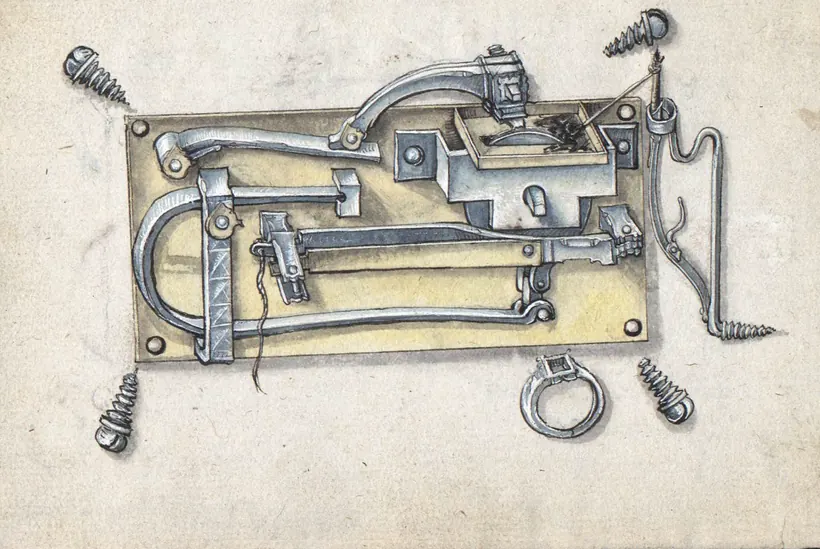
The wheel lock was the first firearm that made its own fire, with no lit match to keep burning. It appeared in the early sixteenth century and strikes its spark the same way a modern cigarette lighter does, by spinning steel against a stone.
To ready it, the shooter wound the wheel against spring tension with a small wrench, the way one winds a clock. A piece of iron pyrite (a hard, brassy mineral that throws sparks when struck, the “fool’s gold” of old prospectors) was held in a movable arm and pressed against the wheel’s edge. Pulling the trigger released the wheel to spin, and the friction of serrated steel on pyrite threw a shower of sparks straight into the priming powder. Because nothing had to be kept burning, a wheel-lock gun could be loaded, primed, and carried ready to fire, which for the first time made a practical holstered pistol possible.
No one inventor can be credited. The earliest designs and references cluster in northern Italy and southern Germany in the first decades of the 1500s, and a sketch in Leonardo da Vinci’s notebooks shows a related mechanism, but they appear close enough together in time that historians cannot point to a single first maker. What is clear is why the wheel lock never became the common soldier’s gun: it was an expensive, intricate piece of near-clockwork, slow to make and prone to fouling and breakage in the field. It armed the wealthy cavalryman and the gentleman hunter, while the infantry kept its cheap matchlocks. Self-contained ignition was the right idea, but it would not reach the common soldier until a simpler and cheaper lock arrived.
The flintlock: flint, steel, and the frontier rifle
The flintlock is the lock that made self-contained ignition cheap and rugged enough for everyone, and it did the job so well that it stayed in service for two centuries: credited to the French gunmaker Marin le Bourgeoys around 1610 to 1615, it was the dominant military and civilian lock until the percussion cap displaced it in the early nineteenth century.
It strikes its own spark instead of carrying a flame. The cock holds a sharp flint in its jaws; pulling the trigger swings it through an arc so the flint scrapes down the hardened steel face of the frizzen, the spring-loaded steel plate standing over the pan. The same blow knocks the frizzen forward, and as it tips it uncovers the flash pan beneath, which holds a pinch of the finest grade of priming powder (FFFFg). The shower of sparks drops into that prime, and the flash runs through the touch hole into the main charge behind the ball. With a sharp flint and a dry pan the whole chain fires almost instantly.
Two cautions come with the system, and both are old buckskinner knowledge. The first is that all that snapping and sparking and flashing happens right beside the sights the shooter is looking through, which makes the flintlock harder for a beginner to master and is part of the challenge that draws people to the old style of ignition. The second is a safety rule: a stray spark can still set off the main charge even when the pan holds no priming powder, so a flintlock is treated as a loaded weapon whether it has been primed or not.
The flintlock’s real handicap is weather. On a damp day, and especially in rain, moisture works into the priming charge and the gun will not fire. The only remedy is care: prime carefully and keep the lock and pan covered against the weather. Even so, the flintlock is among the most rewarding muzzleloaders to shoot, and it is the lock most associated with the colonial and frontier American long rifle.
The percussion lock: the copper cap takes over
The percussion lock, also called the caplock, did away with flint, frizzen, and open pan altogether, replacing the whole sparking arrangement with a single small copper cap of impact-sensitive compound. It came into wide use in the 1820s and 1830s as a direct answer to the flintlock’s two great faults: its vulnerability to weather and its hesitant, fraction-of-a-second ignition.
The principle behind it belongs to a Scottish clergyman. The Reverend Alexander John Forsyth, minister of Belhelvie in Aberdeenshire, patented the use of a detonating compound to fire a gun on the 11th of April, 1807. Forsyth was not the first to notice that certain compounds explode when struck, but he was the first to patent applying that effect to a firearm, and his work opened the door to everything that followed. The familiar percussion cap that grew out of his principle, a thimble of copper holding the compound, came together over the following two decades through several hands; the cap itself, unlike Forsyth’s principle, has no single undisputed inventor.
In use the caplock is far simpler than a flintlock. A percussion cap is pressed onto the nipple, a small hollow cone screwed into the breech. When the trigger releases the hammer, it falls on the cap and crushes it, igniting the fulminate inside; the flame is funneled through a channel in the nipple into the main charge. There is no pan to prime and no flint to knap, and the cap holds its priming compound sealed against the weather, which is why hunters and target shooters took to it quickly. One safety rule carries over and one is new: never let the hammer drop on a bare nipple, as it will batter the metal, and treat the gun as loaded at all times.
The percussion lock was a large step forward, and it was also close to the end of the line for muzzleloading. Within a generation the self-contained metallic cartridge and the breech-loading action arrived, and the muzzleloader passed out of frontline use. The flintlock never entirely disappeared, and it survives in traditional shooting today.
Beneath the visible cock or hammer, almost every muzzleloader lock works the same way. A mainspring stores the power. A tumbler turns on the same axle as the hammer. A sear drops its tip into notches cut in the tumbler to hold the lock at half-cock (the safety position) and full-cock (ready to fire). Drawing the hammer back rotates the tumbler until the sear clicks into the half-cock notch; pulled back further, it catches the full-cock notch. Pressing the trigger lifts the sear out of full-cock, the mainspring drives the tumbler around, and the hammer falls.
Which is better, flintlock or percussion
For the two locks still in common use, the choice is reliability against tradition. The percussion lock is the more dependable by a clear margin: it fires more surely, shrugs off damp, and asks far less of the shooter in the field, which is why it swept the flintlock aside in two decades. If a gun simply has to go off when the trigger is pulled, the caplock is the safer bet.
The flintlock earns its keep the opposite way. It is more demanding precisely because the shooter manages the whole ignition by hand, from knapping the flint to priming the pan, and that, with its tie to the colonial and early-frontier rifle, is why traditional shooters and reenactors prefer it. In several jurisdictions it also carries a distinct legal and hunting-season status that can settle the question on its own. Neither lock is wrong; they answer different wants.
When did percussion replace flintlock
The change ran through the 1820s, 1830s, and into the 1840s, moving from the sporting field outward. Private hunters and target shooters adopted the percussion cap first, through the 1820s; the world’s armies, slower and more cautious with a proven system, converted through the 1830s, and flintlocks had largely vanished from general use by about 1840. On the American long rifle the shift can be dated only loosely, because so many guns crossed over individually rather than all at once.
Converting a flintlock to percussion
Because the percussion cap arrived while millions of serviceable flintlocks were still in daily use, converting an old flintlock to the new system was extremely common; a great many surviving original flintlocks were altered this way. The work was straightforward for a gunsmith. The pan and frizzen were removed, the breech was fitted with a nipple, often by way of a small drum screwed into the touch-hole, and the flint-jawed cock was replaced with a hollow-faced hammer that fell on the cap. A converted lock can often be spotted on an antique by its single mounting screw where a flintlock used two.
Were Kentucky rifles flintlock or percussion
Both, depending on when the rifle was made. The American long rifle, the type usually called the Kentucky rifle, grew up as a flintlock through the eighteenth century, and its celebrated golden age was a flintlock era. When the percussion system arrived, the pattern carried straight across it: early long rifles are flintlocks, a large number of those flintlocks were later converted to percussion, and rifles built new during the percussion era came as caplocks from the start. A long rifle is therefore not inherently one or the other; its lock dates it.
Which locks can be shot today
In practice, two of the four. The flintlock and the percussion lock are both widely reproduced as new rifles, pistols, and muskets, and they make up almost all of the muzzleloaders that hunters, target shooters, and reenactors actually carry. The large traditional-muzzleloader makers, the Italian firm Davide Pedersoli chief among them, build flintlock and percussion guns in quantity. The matchlock and the wheel lock are reproduced only in small numbers by specialist and custom makers, and they remain the province of dedicated historical shooters rather than the general muzzleloading public. A shooter coming to the sport will, in all but the rarest cases, begin with one of the last two locks on this page.
The same mechanisms appear on smoothbore muskets as well as on rifles; the lock is independent of whether the barrel is rifled. What the lock determines is how the gun is lit, and that single choice is the dividing line that organizes the entire muzzleloading era.
Common questions
Which lock should a beginner start with?
For almost everyone, the percussion lock. It has the fewest ways to go wrong: no pan to prime, no flint to knap or adjust, and a sealed cap that shrugs off damp, so a new shooter spends time on the fundamentals rather than on ignition troubles. The flintlock rewards the shooter who wants to manage the whole firing process by hand, but its learning curve and weather-sensitivity make it the harder first gun. The matchlock and wheel lock are not practical starting points; they are built only in small numbers for dedicated historical shooters.
How can you tell a percussion gun from a flintlock at a glance?
Look at the right side of the lock. A flintlock carries a cock holding a shaped flint and, ahead of it, an upright steel frizzen over an open pan. A percussion gun has neither; in their place is a solid hammer with a cupped face and a small nipple or “drum” screwed into the breech where the cap sits. On an antique, a single lock-mounting screw where a flintlock would have used two is a common sign that the gun started life as a flintlock and was later converted.
Are percussion caps and black powder still made for these guns?
Yes. Number 11 caps and musket caps for percussion guns, along with the graded black powders the locks need, remain in regular production for the traditional-shooting market, and the large makers build new flintlock and percussion guns in quantity. The priming and main charges differ by lock: a flintlock takes very fine FFFFg in the pan and a coarser powder behind the ball, while a percussion gun needs only the main charge under its cap. Smokeless powder is never used in any muzzleloader of these types.
What does “half-cock” actually do?
Half-cock is the lock’s safety position. Drawing the hammer back part way lets the sear drop into a notch cut deep enough that the trigger cannot release it, so the gun can be loaded, primed, or capped without the hammer resting on the charge. Pulled all the way back, the sear catches the full-cock notch and the trigger will now fire it. The old warning about “going off half-cocked” comes from a worn or broken notch slipping, which is why the half-cock notch is the first thing a shooter checks on an unfamiliar lock.