Mountain Man Rendezvous: Life in the Fur-Trade Frontier
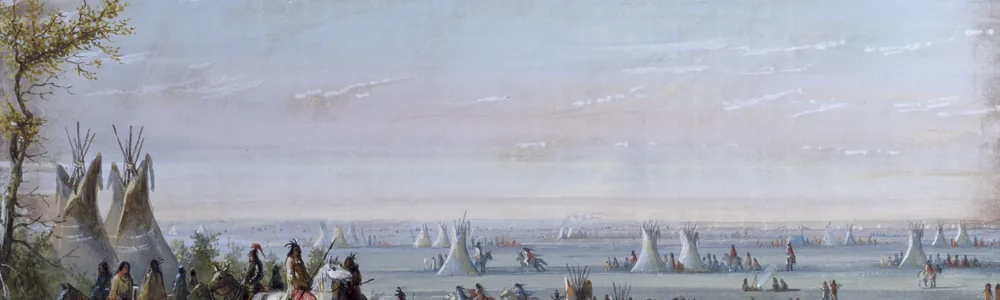
A mountain man rendezvous was the annual summer gathering of the Rocky Mountain fur trade between 1825 and 1840, where trappers came down from the high country to meet supply caravans hauled out from St. Louis, sell a year’s catch of beaver pelts, re-outfit, and trade with one another and with the Plains and mountain tribes. It was a market and a resupply point both, and the camp around it lasted for weeks. The system was devised by the fur entrepreneur William H. Ashley, ran for sixteen seasons, and ended when beaver collapsed as a commodity. The men it produced, among them Jedediah Smith, Jim Bridger, and Thomas Fitzpatrick, became the lasting image of the American mountain man.
For roughly two decades a few hundred men made their living trapping beaver in streams that no eastern map had named, deep in the northern and central Rockies. The rendezvous was the institution that held that world together. Once a year the scattered trappers, the company men, the free trappers working for themselves, and the trading caravans all converged on an agreed valley, and for a few weeks the empty mountains held the busiest market west of the Missouri.
What follows is the economy that paid for the rendezvous, the geography that decided where it met, and the breed of frontiersman it left behind.
The market that came to the trapper
The rendezvous was an annual trade fair held in the open mountains rather than at a fixed post. Each summer a supply caravan set out from the St. Louis area, hauling powder, lead, traps, blankets, coffee, tobacco, and whiskey hundreds of miles up the trail to a valley named the previous year. Waiting there were the trappers who had spent the autumn and spring seasons working the beaver streams, together with bands of Native traders. Pelts changed hands for goods and credit, accounts were settled, the next season’s outfit was bought, and then the camp broke up and the men scattered back to their trapping grounds.
One inversion decided everything: the market came to the wilderness instead of the wilderness hauling its catch out to the market. For a few weeks each summer the high country itself was the trading floor, which is why the era is named for the gathering and not for any fort or town.
The hat that drove the beaver trade
The item that propelled the whole rendezvous was a hat. Through the early nineteenth century the fashionable hat across Europe and the eastern United States was felt pressed from beaver underfur, a dense, water-shedding material unlike any other. Demand for that felt set the price of a pelt high enough that men would spend a year in the mountains to gather them, and high enough that companies would pay to haul tons of supplies into the wilderness to buy them.
That demand had been met the same way for generations: tribes brought their furs to fortified posts on the rivers, traded them for goods, and the bales went out by boat. The Rocky Mountain trade broke that pattern. Instead of waiting at a post for furs to come to him, the trader sent his own men into the mountains to take the beaver themselves, which meant they had to be supplied and bought out where they worked. Trapping was cold, solitary work, done mostly in autumn and spring when the fur was prime, by setting steel traps in the icy streams where beaver built their dams. A man measured his year in packs of pressed pelts, and a year’s packs were a year’s wages, paid out once, at the summer gathering. The arrangement also created a distinct figure, the free trapper, who worked for no company and sold his catch to whichever caravan offered the best terms, unlike the men under contract to one of the fur outfits.
The man who invented the rendezvous
That new way of doing business had a single author. In 1822 the St. Louis businessman William H. Ashley, with the experienced trader Andrew Henry, recruited a party of young men to ascend the Missouri and trap the rivers of the northern Rockies themselves. The venture drew a remarkable group, several of whom became the best-known names of the era, but its first seasons nearly ruined him.
The Missouri route closed almost at once. In the spring of 1823 the Arikara, a river people whose villages controlled the middle Missouri and whose living depended on brokering the fur trade themselves, attacked Ashley’s party as it tried to buy horses, killing about fifteen men in a single morning, the worst day the western trade had yet seen. With the river too dangerous to supply men by, Ashley pushed his trappers overland instead. In 1823 and 1824 a party that included the young Jedediah Smith worked west across the plains, and the broad, gentle saddle they crossed early in 1824, South Pass, gave the wagons a way over the Continental Divide and into the heart of the beaver country. That forced detour is what created the problem the rendezvous solved: with his men now wintering deep in the mountains, Ashley could not expect them to lose a whole trapping season hauling furs back to St. Louis and carrying supplies in. So he sent the supplies to them. In the summer of 1825 a loaded caravan met the trappers at an appointed spot on Henry’s Fork of the Green River, in what is now southwestern Wyoming, and the first rendezvous was held there.
The idea worked, and it set the pattern for the next fifteen years. Ashley sold his interest in the business soon after, but the rendezvous system he had started outlived his involvement and became the defining institution of the Rocky Mountain fur trade.
The Green and the Popo Agie: a market with no fixed home
The gatherings moved from year to year, but they stayed within a fairly small band of country in the central Rockies, chosen for grass, water, and access by the supply trail. The valleys of the Green River in present-day Wyoming, including the Horse Creek bottoms near present-day Daniel, hosted several of the largest gatherings, and other sites lay in the surrounding river valleys of Wyoming, Utah, and Idaho. A trapper of the period spoke of the rendezvous less by a calendar date than by its place: the year on the Green, the year on the Popo Agie, and so on.
These were not the kind of “locations near me” a modern visitor can drop in on as running events; they were working camps that existed for a few weeks and then vanished back into open range. What survives today is the historical record of where they stood, and a handful of interpretive sites and museums in the same country that keep the memory of the trade.
Smith, Bridger, Fitzpatrick: the type the trade made
The rendezvous trade made a particular kind of frontiersman, and a handful of names came to stand for the whole type. Jedediah Smith, who led parties across the Rockies and into the Southwest and California, was among the most far-ranging explorers of the age. Jim Bridger, who entered the mountains as a teenager with Ashley’s men, spent decades in the trade and later founded a trading post on the emigrant trail. Thomas Fitzpatrick, Joe Meek, Jim Beckwourth, and others built reputations in the same seasons.
They shared a set of skills the work demanded: reading country and weather, handling a horse and a rifle in places far from any help, living off what the land gave, and dealing across the cultures of the Plains and mountain tribes, on whose knowledge and trade the whole enterprise depended. The popular picture of the buckskin-clad mountain man with a long rifle across his arm is drawn almost entirely from this short period, and it has outlasted the trade that produced it by nearly two centuries.
The firearm most tied to the mountain man is the Hawken, the short, heavy, large-bore plains rifle built in St. Louis from the 1820s onward. It was made for exactly this country: powerful enough for buffalo and elk, sturdy enough to survive years in the saddle far from a gunsmith. The Hawken reached the mountains alongside the rendezvous trade, and its reputation grew with the legend of the men who carried it. Its full story sits among the other black-powder rifles of the era, and the Hawken has an account of its own.
Trapped out, then out of fashion: the end of the rendezvous
The trade collapsed for two reasons at once: the beaver had been trapped to scarcity across the accessible country, and the silk hat replaced the beaver-felt hat in fashion, so the price of a pelt fell away. With the fur both hard to find and no longer wanted, hauling caravans into the mountains stopped paying. The full account of how the beaver collapsed as a commodity is told separately.
The last of the great gatherings was held in 1840, on the Green River, sixteen summers after the first. The men of the trade did not vanish; many turned to guiding the wagon emigrations then beginning, scouting for the army, or, like Bridger, running posts on the trails. The rendezvous system itself, though, was over, and with it the brief era in which the open mountains held an annual market of their own.
Buckskinning: the tradition kept alive
The fur-trade era never entirely left American memory, and in the modern period it returned as a living-history pursuit. Hobbyists who recreate the dress, gear, camps, and skills of the 1800-to-1840 frontier are known as buckskinners, and the modern rendezvous, organized by muzzleloading and living-history associations, restages the old gathering as a period encampment: canvas and skin lodges, open fires, black-powder shooting matches, and trade goods made by hand to the patterns of the era. The detail runs deep: the same camp foods are cooked over the fire, and the old trade slang is still spoken across the camp.
What was once a year’s livelihood is now a weekend’s craft. The trapper sighted a flintlock because his winter depended on it; the buckskinner sights the same lock for the discipline of doing it the old way. The fur is gone and the market with it, but the camp, the black powder, and the hand skills outlived the trade that invented them, which is why a muzzleloading club today and a fur-trade rendezvous of 1830 still look so much alike across two centuries.
Common questions
Who actually made the money at rendezvous?
The supplier, not the trapper. Goods hauled from St. Louis sold at “mountain prices” marked up many times over: Ashley’s own records put coffee at $1.50 a pound, tobacco at $3 a pound, and blankets at $9 apiece, and whiskey ran as high as $5 a pint. Because a trapper’s furs were credited against those goods rather than paid in cash, the system worked much like a company store, and many men ended a season owing the outfit rather than collecting from it. Ashley made enough on both ends of the deal to retire from the mountains by 1826.
What was the difference between a free trapper and a company trapper?
A company trapper, or engagé, signed on for a fixed term at set wages and was charged the inflated mountain prices for his outfit, which kept many of them in debt. A free trapper worked for no one and sold his catch to whichever caravan offered the best terms, which gave him real bargaining power. When prices grew too steep, free trappers could play one outfit against another; their leverage rose sharply after the American Fur Company entered the trade and began offering higher prices for furs and lower prices for goods.
How was a rendezvous site chosen and announced?
The valley for the coming summer was named a year in advance, at the close of the previous gathering, so the trappers and the supply caravan could both aim for the same spot across hundreds of miles of unmapped country. Sites were picked for open grass, water, and reach of the supply trail rather than for any permanent feature, which is why none became a town. A trapper marked his years by place rather than date, the year on the Green, the year on the Popo Agie, because the location was the fixed appointment everyone had agreed to.
How much of the trade depended on Native nations?
A great deal of it. Plains and mountain tribes attended the gatherings as traders in their own right, bringing pelts, horses, and provisions, and the trappers depended on their knowledge of country, routes, and weather to work and survive in the high country at all. Much of the era’s geography, including the practical crossings the caravans used, drew on routes long known to the tribes. The rendezvous was as much an inter-cultural market as a company resupply.
Why did the rendezvous era end?
Two causes together. Fifteen years of hard trapping had made beaver scarce across the accessible country, and in the later 1830s the silk hat replaced the beaver-felt hat in fashion, so the price of a pelt fell sharply. With the fur worth less and harder to find, hauling supply caravans into the mountains no longer paid. The last rendezvous was held in 1840, and the men of the trade turned to guiding the wagon emigrations, scouting for the army, or running posts on the new trails.
What is buckskinning?
Buckskinning is the modern living-history hobby of recreating the dress, equipment, camps, and skills of the 1800-to-1840 fur-trade frontier. Modern rendezvous events, run by muzzleloading and historical associations, restage the old gathering as a period encampment with skin and canvas lodges, black-powder shooting, and hand-made trade goods. It is the tradition through which the historic fur trade connects to present-day muzzleloading clubs.