Black-Powder Rifles: the Kentucky, the Hawken, and the Sharps
A black-powder rifle is any rifle that uses black powder as its propellant. The term covers two families: muzzleloaders, loaded from the front of the barrel one shot at a time, and black-powder cartridge rifles, which load a self-contained metallic cartridge from the breech but still burn black powder. Three are far better known than the rest: the Kentucky long rifle, the Hawken plains rifle, and the Sharps buffalo rifle.
For roughly two centuries, almost every shoulder arm carried across the American frontier ran on black powder, a mixture of saltpeter, charcoal, and sulfur that left a thick fouling in the bore and a cloud of gray smoke over the firing line. The game a region held shaped the rifle built to hunt it. In the dense eastern woods, the quarry was small and shots were short, so a gunmaker drew the barrel out long for accuracy and kept the bore small, which let a hunter carry far more shots’ worth of lead for the same weight. On the open plains, shots were long and the game was large and dangerous, and a man often fired from horseback: that called for a big bore to drop a bison or a bear and a shorter, handier barrel.
Three rifles trace that shift, each the answer to a different problem. The Kentucky long rifle of the early 1700s was a woodland weapon, long and slender and small in the bore. The Hawken, built from the 1820s on, was its plains-country answer: shorter, heavier, and far larger in caliber, built for men who hunted from horseback and faced animals that did not fall to a squirrel load. The Sharps of the 1850s belonged to a later world entirely, a breechloading cartridge rifle that turned the bison herds into a commercial harvest within a single decade.
The Kentucky long rifle: accuracy out of the eastern woods
When German gunsmiths settled the southeastern Pennsylvania backcountry in the early 1700s, they brought the short, heavy-bored hunting rifles of central Europe with them. Those guns were wrong for the new country, where game was small, lead came dear, and a shot through the trees might be a long one. So the makers remade the rifle to fit the woods. They drew the barrel out past 1.1 meters, cut shallow rifling grooves down its length, and narrowed the bore to a modest .32 to .45. Each of those changes bought a specific advantage. The long barrel gave the patched round ball a slow, complete burn and a long sighting plane; the small bore stretched a fixed weight of lead into many more shots, no small thing where a hunter resupplied rarely and cast his own balls. In skilled hands the result could place a ball on a man-sized target well past two hundred yards, an accuracy the smoothbore muskets of the day could not approach. It was a tool built precisely for a forest economy of deer, squirrel, and turkey, where shots were deliberate and lead was precious.
That basic form held for well over a century, even as the way it was fired changed underneath it. The earliest long rifles were flintlocks, and most of the celebrated examples from the Revolutionary period are. As percussion ignition spread through the first half of the nineteenth century, later rifles were built as caplocks or converted from flint, the percussion system becoming predominant after roughly 1850. What finally overtook the long rifle, though, was not any change in ignition but a change in country: the frontier was moving west, out of the woods the rifle had been built for and onto open plains it did not suit.
One footnote on the name. The weapon that emerged was neither invented in Kentucky nor, strictly, European any longer. The label “Kentucky rifle” came later, from the frontier where it earned its reputation; the more accurate term is the Pennsylvania or American long rifle.
The Hawken rifle: the plains-country standard
On that open country, the very features that had made the long rifle deadly in the woods worked against it. A delicate, small-bore barrel over a meter long was awkward on horseback and underpowered against bison, elk, and grizzly. The rifle that answered the plains came out of a single St. Louis shop, where the brothers Jacob and Samuel Hawken traded as J. & S. Hawken from 1825. The type they built has carried the family name ever since, generically the plains rifle or mountain rifle.
A shorter, much heavier rifle than the Kentucky long rifle it descended from, the Hawken was built around a large bore, commonly .50 to .54 caliber, averaging about .54, with surviving examples ranging as large as roughly .68. By the rifle’s heyday, ignition was percussion (caplock); earlier examples were flintlock, with the percussion lock becoming dominant on the Hawken by about 1835, ahead of the older eastern long rifles, which held to flint longer.
Everything about the Hawken was a response to the plains. The barrel was cut shorter and made thicker, so it balanced for a mounted man and stood up to heavy charges of powder. The large bore threw a ball heavy enough to drop the largest game on the continent, and plain, stout furniture let the rifle survive years away from any gunsmith. The result was not elegant, but it was trusted, and that trust did something to the name. Reliability made “Hawken” a generic word for the mountain man’s rifle, so trappers like Jim Bridger and Kit Carson are remembered as Hawken men whether or not every gun they carried came from the brothers’ shop. The legend kept growing past the rifles the brothers actually built, until even the Hawken that Robert Redford carries in the 1972 film Jeremiah Johnson stands as a symbol of the type rather than an accurate copy of one.
The brothers’ own rifles stopped being made long ago. The St. Louis shop closed in 1915, so every Hawken built today is a replica of the pattern, from makers such as the Italian firm Davide Pedersoli.
→ Read the full Hawken rifle guide
The Sharps: the rifle that ended the herds
The Kentucky rifle and the Hawken were two answers to one question: how to fit a muzzleloader to its country. By the middle of the century the country had stopped being the limiting factor. Loading one ball at a time down the barrel was slow, and as metal cartridges and breech-loading actions matured, that old method was running out of time. The rifle that displaced it was the Sharps, and it worked nothing like what came before. Christian Sharps patented his action in 1848: a single-shot, falling-block breechloader, in which a lever drops the breechblock to expose the chamber from the rear. It still counts as a black-powder rifle, because its cartridges were charged with black powder, but it loaded from the breech and used a self-contained metallic cartridge, putting it a generation ahead of the Hawken in everything but propellant.
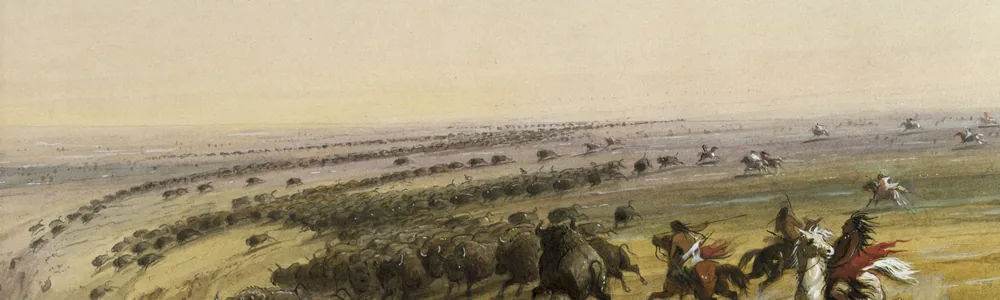
Its lasting fame comes from the buffalo range of the 1870s. Large-caliber Sharps rifles, chambered for heavy cartridges such as the .50-90, .45-70, and .50-70, became the commercial hide hunter’s tool of choice on the Great Plains, able to take bison at long range and fire all day. (The .50-70 reached many hunters through conversions of earlier military arms.) Within a few years the Sharps and rifles like it had brought the bison herds close to extinction, and that history still colors how the rifle is remembered.
The same long-range capability gave the Sharps a second life as a target rifle, and it remains a mainstay of black-powder cartridge shooting today. That afterlife is now a formal discipline: black-powder cartridge rifle silhouette and long-range matches are sanctioned by the National Rifle Association, the silhouette format formalized as an NRA event in 1985, with replica Sharps and Remington Rolling Block rifles common on the line. It is the same long-range marksmanship the Sharps was built for, shot now at paper and steel rather than bison. The rifle reached a wide modern audience through the 1990 film Quigley Down Under, whose hero carries a long-range Sharps chambered in .45-110.
Muzzleloader or cartridge: where the line falls
The Sharps raises an obvious question: if it burns black powder, why is it not a muzzleloader? A muzzleloader is charged from the front of the barrel, with loose powder poured down the bore and a projectile rammed down on top of it; the Kentucky and Hawken rifles are both muzzleloaders. A black-powder cartridge rifle, or BPCR, loads a complete cartridge from the breech, as the Sharps does. Both are black-powder rifles; only the muzzleloaders are loaded the old way.
| Rifle | Era of use | Loading | Ignition | Typical caliber | Built for |
|---|---|---|---|---|---|
| Kentucky long rifle | 1700s–mid 1800s | Muzzle | Flint, later percussion | .32–.45 | Eastern woodland game |
| Hawken plains rifle | c. 1825–1860s | Muzzle | Flint, then percussion (after c. 1835) | .50–.54 (up to ~.68) | Plains & mountain big game |
| Sharps | 1850s–1880s | Breech (cartridge) | Percussion cap, then cartridge primer | .45–.50 class | Buffalo hunting, long-range target |
That distinction also explains the two kinds of projectile in use. The traditional muzzleloader load is the patched round ball: a spherical lead ball wrapped in a greased cloth patch that grips the rifling and seals the bore. The elongated conical bullet came later. The famous Minié ball, developed around 1847 to 1849, came into its own in the Crimean and American Civil Wars, which places it in the closing decades of the muzzleloading era rather than its frontier prime.
Black powder, by the grade
Whichever rifle burns it, black powder is graded by grain size, and the grades carry through every type on this page. They run from coarse to fine: Fg, FFg, FFFg, and FFFFg. The coarser grades suit the larger bores: Fg for the biggest rifles and shotguns, FFg for medium and small bore, while the finer FFFg serves small-bore rifles and pistols and the very fine FFFFg is reserved for priming the pan of a flintlock. A black-powder rifle takes the grade matched to its bore, and the principle holds whether the rifle is a colonial long rifle or a plains Hawken.
Common questions
What is a black-powder rifle?
A black-powder rifle is any rifle that uses black powder as its propellant rather than modern smokeless powder. The term spans two types: muzzleloaders, which are loaded from the front of the barrel one shot at a time, and black-powder cartridge rifles, which load a self-contained metallic cartridge from the breech but still burn black powder. The Kentucky long rifle and the Hawken are muzzleloaders; the Sharps is a black-powder cartridge rifle.
What is the difference between a muzzleloader and a black-powder cartridge rifle?
A muzzleloader is charged from the front of the barrel: loose powder is poured down the bore, then a projectile is rammed down on top of it, one shot at a time. A black-powder cartridge rifle loads a complete, self-contained cartridge from the breech, at the rear of the barrel, and is far faster to reload. Both burn black powder, which is why both count as black-powder rifles. The Kentucky and Hawken rifles are muzzleloaders; the Sharps is a black-powder cartridge rifle.
Were Kentucky rifles flintlock or percussion?
Both, depending on the era. The early Kentucky long rifles, including most surviving examples from the Revolutionary period, were flintlocks. As percussion ignition spread through the first half of the nineteenth century, later long rifles were built as percussion caplocks or converted from flintlock, with percussion becoming predominant after about 1850.